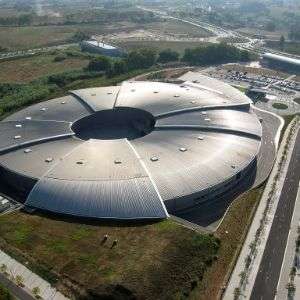
ALBA Synchrotron was inaugurated on Monday 22 March, being the largest and most complex scientific facility ever constructed in Spain, with the objective of working as a large microscope to allow scientists to discover the secrets of matter structure at atomic and molecular levels. It is a 3rd generation Synchrotron Light facility located in Cerdanyola del Vallès, (Barcelona), being the newest source in the Mediterranean area. It is a complex of electron accelerators to produce synchrotron light, which allows the visualization of the atomic structure of matter as well as the study of its properties. It is co-financed in equal parts by the Ministry of Science and Innovation and Generalitat de Catalunya.
The 3 GeV electron beam energy at ALBA is achieved by combining a LInear ACcelerator (LINAC) and a low-emittance, full-energy BOOSTER placed in the same tunnel as the STORAGE RING. ALBA’s 270 meter perimeter has 17 straight sections all of which are available for the installation of insertion devices. ALBA currently has eight operational state-of-the-art beamlines, comprising soft and hard X-rays, which are devoted mainly to biosciences, condensed matter (magnetic and electronic properties, nanoscience) and materials science. Additionally, four beamlines are in construction (low-energy ultra-high-resolution angular photoemission for complex materials, microfocus for macromolecular crystallography, absorption and diffraction and fast X-ray tomography & radioscopy). This large scientific infrastructure provides more than 6.000 hours of beam time per year and is available for the academic and the industrial sector, serving more than 2.000 researchers every year. Since as early as 2012, ALBA has been hosting official users, 65% from Spanish institutions and 35% from other countries.
12 years after its inauguration, ALBA keeps delivering and maintaining methods and techniques with which to conduct cutting edge synchrotron light-based research and development, in such a way that knowledge and added value data are pumped into the scientific and industrial communities with the ultimate goal of contributing to the improvement in the well-being and progress of society as a whole. ALBA has become an exceptional tool for science in Spain and internationally, with the performance of more than 2,500 experiments published in more than 2,400 scientific publications. Most of these experiments are framed in one of its 5 strategic research lines: Materials for energy-related applications, Magnetic nanomaterials, Catalysis and environmental sciences, Drug design/characterization and biological processes involving drugs, and Instrumental developments.
In order to keep delivering cutting-edge science, knowledge transfer and competitiveness, the ALBA II project foresees transforming ALBA Synchrotron from 3rd to 4th generation, through the partial replacement of the accelerator, the construction of new beamlines and the upgrade of some components of the existing beamlines. The so-called 4th generation synchrotron facilities, compared to those of the 3rd generation, produce a brighter and more coherent photon beam. When analyzing matter, they provide inaccessible capabilities as of today, in terms of resolution, detection levels and the understanding of chemical and electromagnetic properties. In addition, they offer new technological approaches to solve society’s challenges more efficiently and move towards a sustainable and smart economy in a more efficient health system.
The ALBA Synchrotron is a Spanish Singular Scientific and Technical Infrastructure (ICTS), such as the Balearic Islands Coastal Ocean Observing and Forecasting System, the Solar Platform of Almería, or the Canary Islands Observatories.