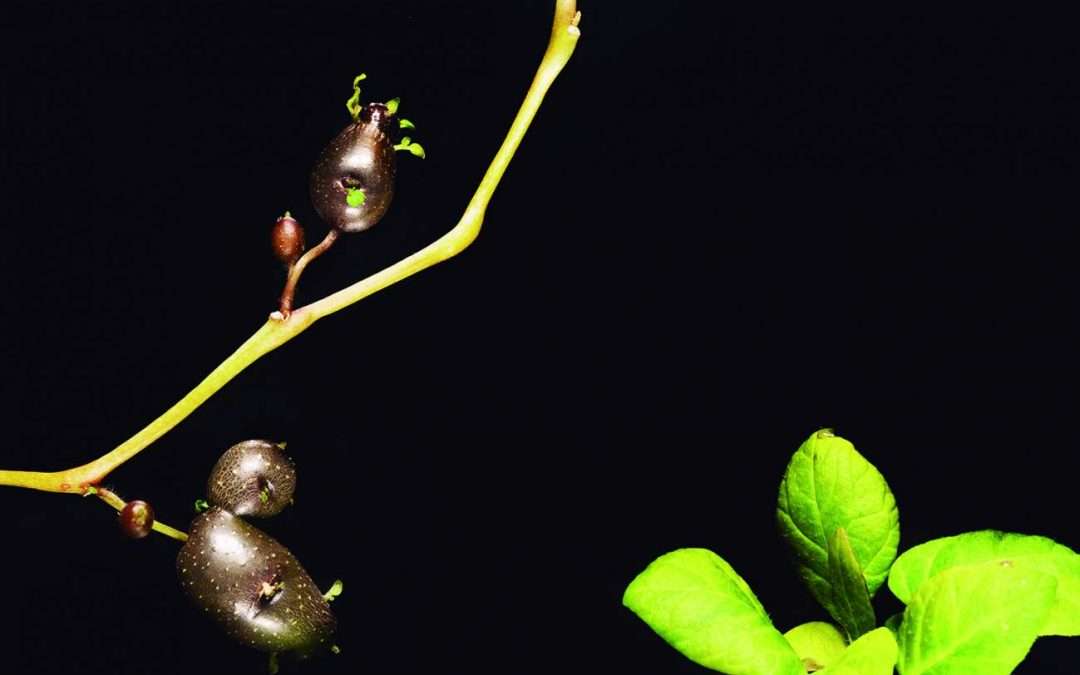
Researchers at the National Center for Biotechnology (CNB-CSIC) in Madrid have identified a new function of the BRANCHED1b (BRC1b) gene, which has turned out to be essential for the formation of underground tubers. The study is on this week’s cover of the journal Nature Plants.
The work led by Pilar Cubas (CNB-CSIC), in collaboration with Salomé Prat (Centre for Research in Agricultural Genomics, Barcelona), shows that mutations in this gene affect the ability to distinguish between aerial and underground stems (called stolons) in potato plants. In this way, in the mutant plants, there is an erroneous distribution of the sugars and of the signals that control the formation of tubers and they develop aerial tubers.
According to Cubas, “using wild and mutant potato plants that did not express this gene as a model, we studied the formation of aerial and underground stems —stolons— for six weeks. Thus we observed that the mutants produced more aerial stems, but fewer stolons than the wild plants”.
The researcher emphasizes that, however, “the most striking change referred to the formation of tubers: the mutants produced much fewer underground tubers and smaller ones, and also began to produce aerial tubers.”
Michael Nicolas, CNB-CSIC researcher and first author of the work emphasizes “when this gene does not work correctly, the plant does not distinguish between aerial branches and stolons and allows the entry of sugar and signals that promote the formation of tubers in aerial axillary buds. Thus, after a few weeks in conditions that simulate winter and short days, the plants begin to develop a surprising number of tubers in the aerial part of the plant”.
For Cubas “although a priori from the agronomic point of view it could be interesting to harvest potatoes without having to dig them up, this is not adaptive in nature, since the tubers, which are fundamentally winter survival organs, would be exposed to inclement weather and foraging animals.
On the other hand, these results help to better understand the molecular mechanism of sugar partitioning and accumulation in tubers and have broader agricultural importance, since other species that produce tubers, such as sweet potato and cassava, will possibly have BRC1b genes that could play a similar role in those species.
Source: SINC